How to Identify Churn Risks Before Users Uninstall
Predict and Prevent App Churn with Data-Driven Strategies
March 4, 2026
Jump to section
Did you know that 80% of users who experience a crash within the first session will uninstall your app within 48 hours? Churn is a constant challenge for mobile apps, and understanding it is crucial to improving retention.
Industry benchmarks show that 30-day retention for typical mobile apps hovers around 20% (Branch). To prevent uninstalls, it's vital to detect early signs of user disengagement such as short sessions, error spikes, and frustrating navigation loops and proactively score users using predictive models.
By doing this, you can trigger targeted interventions and save users from uninstalling before it's too late. In this article, we'll explore how you can predict churn before users abandon your app for good, ensuring you stay ahead with data-driven strategies that improve retention and conversion.
What Is App Churn and Why Users Leave
Having the right tools to monitor these metrics is crucial. With Vexo's intuitive dashboard, you can track Active Users, Session Time, and Drop Off to quickly identify users at risk of churn before they decide to uninstall.
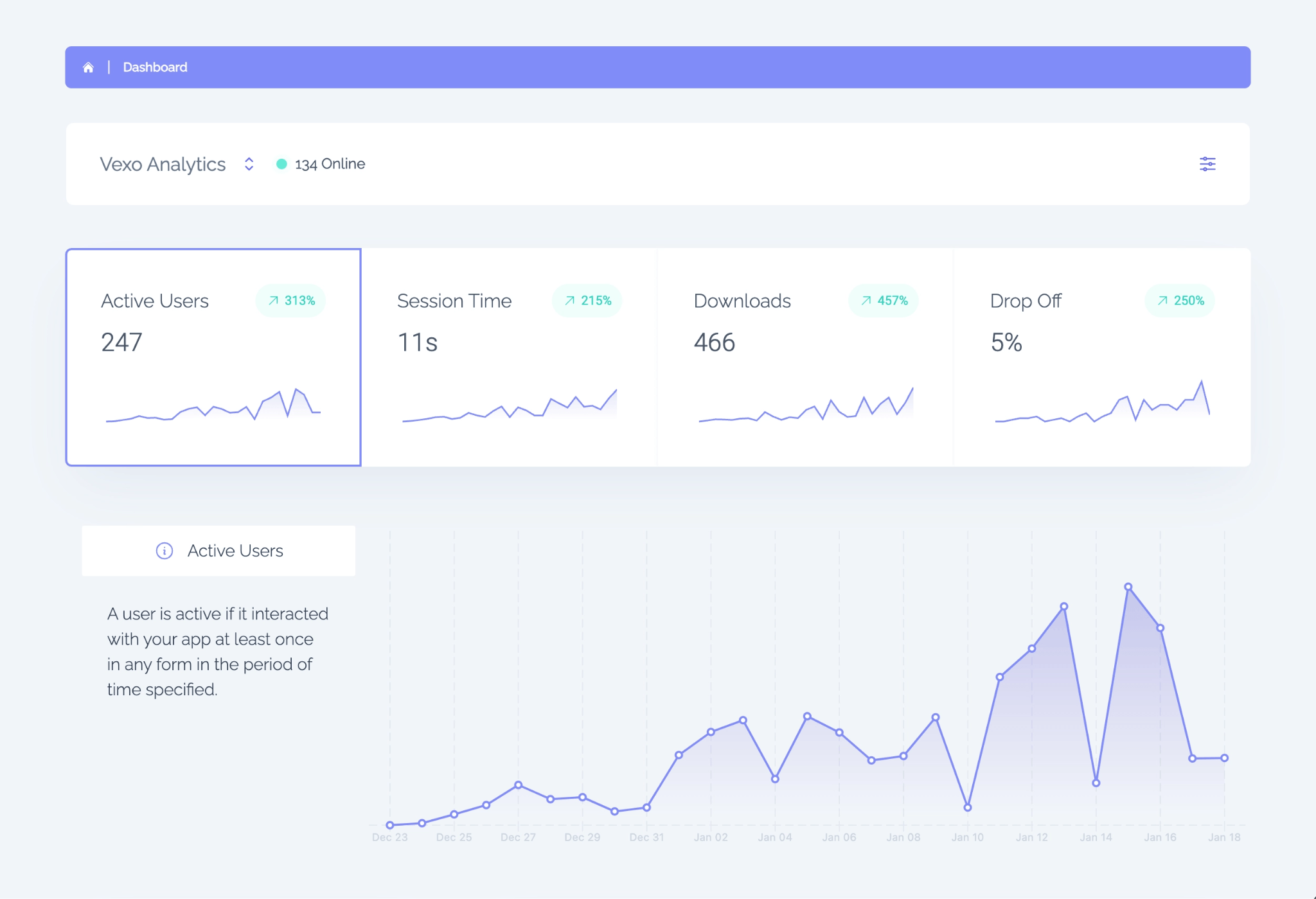
Churn measures the proportion of users who stop using or uninstall an app within a defined window; common windows are 7-day, 30-day, and 90-day retention.
Retention is the inverse of churn: if 30-day retention is 20%, that implies a ~80% cohort loss within 30 days (benchmark context).
Primary causes of uninstall are measurable and typically include technical failure, poor first-time experience, and irrelevant value delivery.
Trackable signals that correlate with churn include crash rates >1–2% of sessions and session length under 30 seconds on the first three opens, both strong predictors of near-term uninstall.
Which Behavioral Signals Reliably Predict Churn?
High-precision signals come from navigation and engagement metrics. Here are key behavioral signals that can help predict churn:
In addition to engagement metrics, error telemetry plays a crucial role in improving churn predictions. Frustration patterns to look out for include:
- Rage taps: Repeated, quick taps on the same UI element, typically three or more within 30 seconds, signal frustration.
- Repeated back navigation: Users who continuously navigate back indicate confusion or dissatisfaction with the app's flow.
- Error screen exposure: Users who encounter error screens multiple times in one session are at high risk for churn.
To proactively address these risks, define thresholds for these frustration patterns. For example:
- 3+ rage taps within 30 seconds
- 2+ identical errors in one session
These thresholds help flag users for remediation, allowing your team to intervene before they decide to uninstall the app.
Tools and Techniques for Churn Prediction
To effectively predict churn, it's crucial to combine event-driven analytics with simple predictive models that score churn probability based on user behavior.
By focusing on key features like session cadence, time-to-first-key-action, crash count, and recency of the last session, you can create a reliable churn prediction model.
| Technique | Description | Recommended Metrics | Target |
|---|---|---|---|
| Event-driven analytics | Use event-driven analytics to collect user data based on actions and interactions. | Session cadence, time-to-first-key-action, crash count, recency of last session | Score churn probability per user daily. |
| Predictive models | Implement simple predictive models (e.g., logistic regression, random forest) to predict churn. | Look for patterns in user behavior and engagement to predict the likelihood of churn. | Aim for AUC ≥ 0.75 in early deployment. |
| Vexo | A platform that provides out-of-the-box dashboards and cross-platform capture. | Supports React Native and Web, with offline support and privacy-friendly defaults. | Use to reduce instrumentation time and simplify deployment. |
| Model retraining | Retrain predictive models regularly to ensure accuracy. | Retrain models every 7–14 days with at least 1,000 labeled users per cohort. | Stabilize estimates for more accurate churn predictions. |
How to Map User Navigation to Find Churn Touchpoints
Implement a map of key user paths and funnels: onboarding → key activation → engagement → retention. Instrument at least 10 core events (onboarding steps, core feature calls, error screens) to create reliable funnels and heatmaps.
Use time-based metrics: measure average time between screens in seconds and conversion drop between adjacent screens. If you observe a conversion drop >30% between two consecutive steps, that screen is a high-priority friction point.
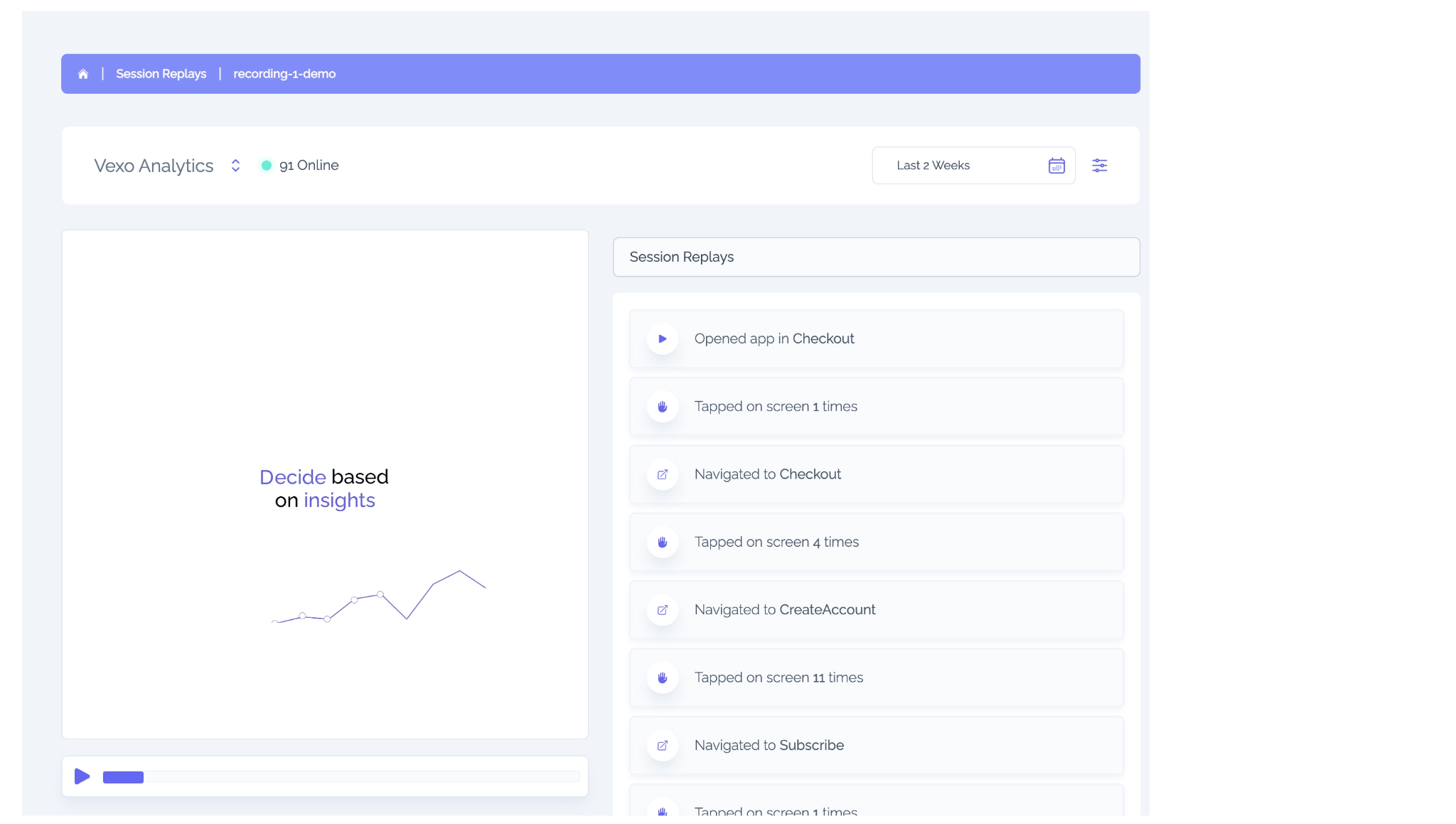
By using session replays, you can visualize how users interact with your app, identify frustration points, and determine which screens are causing users to drop off. This allows you to pinpoint exactly where improvements need to be made to prevent churn.
Behavioral Signals, Thresholds, and Recommended Actions
Here's a quick overview of the key behavioral signals and the actions you should take when certain thresholds are met:
| Signal | Threshold | Immediate Action |
|---|---|---|
| First-session length | <30 seconds | Show abbreviated onboarding + contextual help message |
| Rage taps / repeated back | 3+ events within 30s | Open in-app support prompt and record video session |
| Crash or error recurrence | 2+ identical errors in a session | Trigger automatic bug-report collection and priority bug ticket |
Actions to Take When a User Is Flagged at Risk
Segment flagged users and run targeted treatments: brief in-app guidance, feature tips, friction removal, and time-limited incentives. Run A/B tests with sample sizes of at least 500 users per arm to measure lifts with statistical power.
Automated recovery flows work best when combined: send an in-app contextual nudge within 48 hours of the risk signal and a follow-up email or push within 7 days if the user remains inactive.
Implementation Checklist (Fast Path Using Vexo)
Start by instrumenting core events with Vexo Quickstart. With Vexo's React Native optimization and zero-coding approach, you can have basic analytics live in under an hour for simple apps.
Steps for Implementation:
- Install the Vexo SDK: Begin by installing the Vexo SDK to your app.
- Emit 10-15 Essential Events: Track the most critical events for understanding user behavior, like screen views, app interactions, and errors.
- Validate Out-of-the-Box Dashboards: Use Vexo's pre-built dashboards to confirm data collection is functioning correctly and visualize paths immediately.
Recommended First Milestones:
- Create Retention Cohorts: Segment users into 3 cohorts based on time of usage: 0–7 days, 8–30 days, 31–90 days
- Build Churn Probability Score: Generate a daily churn probability score for each user to predict churn risks.
- Enable Automated Remediation Workflows: For users with a churn probability greater than 0.6, trigger automatic interventions to retain them.
To Reduce Onboarding Friction:
- Instrument Step Completion Rates: Track the completion rates for each step in your onboarding process.
- Track Time-to-First-Success Metric: Measure how long it takes for users to achieve their first meaningful action in the app.
- Iterate for Early Success: After tracking these metrics, aim to increase first-week activation by at least 10%.
- Implement Contextual Guides: Use contextual in-app guidance to help users complete onboarding smoothly and improve user flow.
Measuring Impact and Continuous Improvement
Track lift using cohort analysis: measure 7-, 30-, and 90-day retention before and after interventions. A realistic initial goal is to achieve a 5–10 percentage point increase in 30-day retention for treated cohorts within 8–12 weeks.
Operational metrics to monitor weekly: active users, churn probability distribution, mean session length (seconds), and crash-free sessions percentage. Use these metrics to prioritize product fixes and to inform roadmap trade-offs.
Case Examples: Behavioral Patterns That Led to Uninstall
Example 1: A cohort showed median first-session length of 18s and 65% drop-off before onboarding completion; after simplifying onboarding and adding inline guidance, first-week retention rose by 12 percentage points. This pattern is classic early-value friction.
Example 2: An app experienced a 3x increase in error reports within a week after a release; automated flags routed affected users to a hotfix and a targeted message, reducing churn in that release cohort by 7 percentage points over 30 days.
Start Using Churn Prediction Tools Now
Implement a light-weight analytics stack, score users daily, and automate one remediation flow within the first 30 days.
Tools like Vexo let teams ship this quickly with cross-platform capture and prebuilt dashboards. Start with Vexo for free and iterate on the most predictive signals for your product.
Operationalize learnings: document interventions, measure cohort lifts, and make continuous retraining part of your weekly cadence to keep models aligned with product changes.
Frequently Asked Questions
How quickly can I get churn signals after instrumenting events?
You can start capturing raw churn signals immediately after instrumenting events. However, to generate reliable churn predictions, you typically need 7–14 days of labeled data. A cohort of several hundred users is ideal for accurate probability estimates.
Which events are most important to predict uninstall?
Key events to track include first-session duration (under 30 seconds), time-to-first-key-action (how long it takes users to engage), crash/error counts, and session frequency.
What model performance should I expect initially?
In the early stages, expect an AUC score of 0.70–0.80. This is a solid baseline but can improve with feature engineering, cohort stratification, and a larger training set.
Which retention tools integrate quickly with React Native?
For React Native, Vexo is ideal due to its zero-configuration setup and real-time data capture. Firebase Analytics also works well, offering scalable event tracking.
How do I evaluate whether an intervention reduced churn?
Use A/B testing to compare treatment and control groups. Track 7, 30, and 90-day retention and look for a 5 percentage point increase in retention for the treatment group.
